Bob and Marcia Smith recorded an episode of The Off Ramp featuring historical, scientific, geographic, cultural, and wordplay trivia.
Trivia Highlights
- Teachers receive the most Valentine cards in the United States, followed by children, mothers, wives, husbands, and sweethearts; pets also rank among the top recipients.
- Finland awards successful Ph.D. candidates a degree, doctoral hat, and doctor’s sword.
- The masseter is the strongest muscle by force, producing up to 200 pounds on the molars; the gluteus maximus is the largest muscle.
- Sunflowers contain roughly 150 to 1,000 tiny flowers per stem.
History And Culture
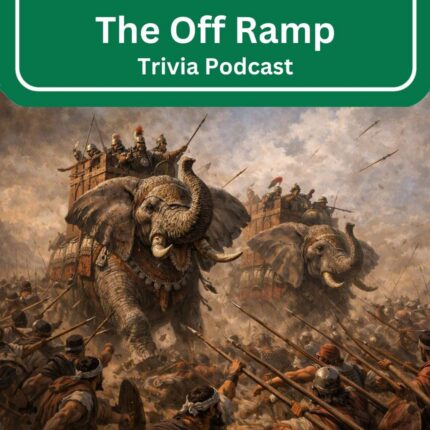
- First and Second Maccabees describe Seleucid war elephants near Jerusalem around 162 BC, an episode connected to the origins of Hanukkah.
- Purple-dyed textiles found with two Roman infants in York were worth more than gold because the dye required thousands of mollusks.
- The New Madrid earthquakes of 1811–1812, including the February 7, 1812 quake, were among the largest in United States history and caused the Mississippi River to flow backward.
- Superstitions discussed included knocking on wood, breaking mirrors, walking under ladders, black cats, and opening umbrellas indoors.
Geography And Games
- The United States, Liberia, and Myanmar were identified as metric-system holdouts.
- Moscow State University’s main building is the world’s tallest university building at 787 feet.
- Singapore is one of three surviving city-states and includes 63 additional islands; Antarctica has no official time zone.
- The episode also featured the burger-topping word game AKA and leadership quotations from Ken Blanchard, John C. Maxwell, and the Dalai Lama.
Outline
Opening And Valentine Trivia
- Introduction to The Off Ramp and its focus on fascinating facts and trivia.
- Discussion of Valentine card recipients, with teachers ranked first and children second.
Biblical And Military History
- First and Second Maccabees describe armored Indian elephants carrying wooden towers in battles near Jerusalem.
- The Maccabee revolt eventually led to Hanukkah; one fighter became a martyr after attacking an elephant.
AKA Word Game
- Burger toppings were identified through clues involving Colonel Mustard, predicament and pickle, Mayo Clinic, ketchup, let us, and relish.
International Facts
- Finnish Ph.D. graduates receive a sword as a symbol of scientific pursuit.
- The United States, Liberia, and Myanmar were discussed as countries that do not use the metric system.
- Moscow State University’s 787-foot main building was identified as the world’s tallest university building.
- Agnes Gonxha Bojaxhiu was identified as Mother Teresa, who received the 1979 Nobel Peace Prize.
Science And Archaeology
- Purple textiles in British Roman graves were valued above gold because Tyrian purple required thousands of mollusks.
- The jaw’s masseter muscle can exert up to 200 pounds of force.
- Sunflowers are composite structures containing hundreds of individual flowers.
Superstitions And Commerce
- Origins of knocking on wood, breaking mirrors, walking under ladders, black cats, and opening umbrellas indoors were reviewed.
- The Sears catalog once sold dynamite, fuses, wires, and blasting machines, including a 1902 listing for stump removal.
Earthquakes And Geography
- The 1811–1812 New Madrid earthquakes affected a region larger than the 1906 San Francisco earthquake and caused the Mississippi River to reverse direction.
- Singapore was identified through clues about its currency, city-state status, and surrounding islands.
- Antarctica has no official time zone; research stations generally use the time of their home or nearby countries.
Closing
- Leadership quotations emphasized service, collaboration with capable associates, integrity, compassion, and individual impact.
- The episode invited listeners to submit questions and comments through the Off Ramp
Marcia Smith 00:00
Hello, Bobbi. This is Marci Bobby.
Bob Smith 00:05
Well, you’re in a good form today.
Marcia Smith 00:06
Why?
Bob Smith 00:06
I don’t know. We’ll change that.
Marcia Smith 00:10
I’m sure you will.
Bob Smith 00:11
No, we won’t.
Marcia Smith 00:12
Yes, you will. Is it on?
Bob Smith 00:13
Yes.
Marcia Smith 00:14
Okay, Bob. Who receives the most Valentine cards every year?
Bob Smith 00:19
And what’s the most unusual animal found in Bible battle scenes. Answers to those and other questions coming up in this episode of The Off Ramp with Bob
Marcia Smith 00:29
and Marcia Smith.
Bob Smith 00:46
Welcome to the Off Ramp, a chance to slow down, steer clear of crazy, and take a side road to sanity with fascinating facts and tantalizing trivia. This is the podcast dedicated to lifelong learning and fun.
Marcia Smith 00:59
Fun.
Bob Smith 01:00
And what is your question today?
Marcia Smith 01:02
What group of people receives the most Valentine cards every year?
Bob Smith 01:07
Well, little kids. Little kids get the most Valentine’s cards. Second grade, first grade, you get all your friends.
Marcia Smith 01:12
No, they’re second. They’re second in the list of top six.
Bob Smith 01:15
Oh, really? So this is throughout all of society.
Marcia Smith 01:17
All of America.
Bob Smith 01:19
All of America. Yeah. Who receives the most? I don’t know, Marsh. Can you give me any hints?
Marcia Smith 01:26
No.
Bob Smith 01:26
Okay. What’s the answer
Marcia Smith 01:29
It’s the teachers.
Bob Smith 01:30
Oh, of course, that makes sense.
Marcia Smith 01:33
Yes. You don’t think of that right away.
Bob Smith 01:34
I never did.
Marcia Smith 01:35
Yeah, they receive the most. Children are number two, followed by mothers. Mothers, okay, wives, then husbands.
Bob Smith 01:44
Oh, husbands are like fifth down the list,
Marcia Smith 01:46
and then sweethearts.
Bob Smith 01:47
Oh, what’s sweethearts – mistresses?
Marcia Smith 01:51
But who do you think is number six?
Bob Smith 01:53
I don’t know.
Marcia Smith 01:53
Pets.
Bob Smith 01:54
Oh my goodness! Pets are in the top 10 of Valentine recipients.
Marcia Smith 01:59
Yeah.
Bob Smith 02:00
Oh dear.
Marcia Smith 02:01
I hope they enjoy them. I wonder if they get boxes of chocolate. That’ll kill them.
Bob Smith 02:04
I don’t think they do.
Bob Smith 02:06
Okay. All right, Marcia. What’s the most unusual animal you’ll find in Bible battle scenes? This just blew my mind. I never heard of it.
Marcia Smith 02:16
What is this Old Testament, is that what we’re talking about?
Bob Smith 02:19
It’s in the Apocrypha. So it’s the books that weren’t included in the canon, but they’re considered ancient writings and so forth. And it was in the book of Maccabees.
Marcia Smith 02:27
Maccabees
Bob Smith 02:28
first and second Maccabees. These describe the Jewish revolt against the Seleucid Empire. Actual elephants are described in battle. Somewhere between 30 and 32 armored, trained elephants carrying wooden battle towers on their backs.
Marcia Smith 02:45
Well, I wouldn’t have guessed that, Bob.
Bob Smith 02:47
Picture a massive Indian elephant, 10 feet tall, at the shoulder, with this timber fortress strapped to its back. Uh huh. And the Seleucids had four soldiers in each one of these, on top of the elephants. And the towers gave the archers and the javelin throwers a mobile fortress. This must have been terrifying.
Marcia Smith 03:03
Yes.
Bob Smith 03:03
This battle occurred about 10 miles from Jerusalem. I never thought of elephants being there. Yeah. But the Macedonian Greeks, their founder was Nicatr. He was one of Alexander the Great’s generals, so they were ruling over the Jews before the Romans. And in this war, one of the things they did that ticked off the Jews was they put a statue of Zeus, their Greek god, in the temple in Jerusalem.
Marcia Smith 03:27
Oh, really?
Bob Smith 03:28
That set off the revolution by the Maccabee family, and they went to war.
Marcia Smith 03:33
Uh huh.
Bob Smith 03:33
And it didn’t end fast like the Greeks thought it would. It went on for years, and the Seleucids escalated the conflict by bringing in their Indian war elephants. So imagine these huge animals nobody’s ever seen before. Loud thundering, coming in through a canyon. The ground shaking, and these huge elephants attacking Jews who are on foot with spears.
Marcia Smith 03:54
Really?
Bob Smith 03:54
Oh my goodness! Well, in one of these battles, just 10 miles from Jerusalem, the brother of the leader of the revolt, he saw one of the elephants and he thought up in that fortress might be the Seleucid king, so he ran up underneath that elephant and he stabbed it with his spear.
Marcia Smith 04:10
Oh my God!
Bob Smith 04:11
And the elephant collapsed on him, killing him, making him a martyr.
Marcia Smith 04:15
Oh dear! The elephant collapsed and the guy died.
Bob Smith 04:18
Yeah, he became a martyr. This battle is in not only the Bible, but it’s described in the works of the Roman historian Josephus. So it really happened. These battles with elephants in the Bible-I couldn’t believe it. I never heard of it before. It certainly wasn’t something I learned in Sunday school. But that was a suicide mission to go in there and try to to stop this one elephant. It didn’t stop the battle, but they eventually won the war.
Marcia Smith 04:43
Wow, that blows my mind.
Bob Smith 04:45
And this war eventually led to the holiday of Hanukkah, so it’s very famous in Jewish history.
Marcia Smith 04:50
Okay, so that’s how that all came about
Bob Smith 04:53
in 162 BC.
Marcia Smith 04:56
Sounds like a little bit of the Odyssey movie, doesn’t it? It does, doesn’t it?
Bob Smith 05:00
It did remind me of that. The Greeks used Indian elephants in battle from Turkey down to where Israel is today, and the Romans, the Ptolemies, used Egyptian elephants in battle. And of course, Hannibal attacked the Roman Empire with elephants – that was about 60 years before this battle -by going up from Spain, traveling through France, and going down through Italy, and most of those elephants died up in the Alps. I mean, my God, it’s just an amazing story. But I didn’t realize there were ever elephants in battle in biblical times, 10 miles from Jerusalem, two centuries before Christ. I had no idea. Never heard of this.
Marcia Smith 05:40
Well, give me Ringling Brothers. Okay, okay, Trophy Husband, it’s time for AKA.
Bob Smith 05:46
Oh, Also Known As
Marcia Smith 05:48
That’s right.
Bob Smith 05:48
It’s the the game where you give me clues for words, right?
Marcia Smith 05:52
That’s right.
Bob Smith 05:52
All right.
Marcia Smith 05:53
Today’s category is burger toppings, something we both know very well.
Bob Smith 05:58
Okay. Okay. All right.
Marcia Smith 05:59
So, for instance, if I said Colonel from the game Clue, what’s the topping?
Bob Smith 06:04
Mustard.
Marcia Smith 06:05
That’s right.
Bob Smith 06:06
That’s right, Colonel Mustard.
Marcia Smith 06:07
And if I said the word predicament, uh huh, what’s the burger topping?
Bob Smith 06:12
Predicament. Predicament. It’s not ketchup. It’s not mustard. It’s not. Oh, it’s a pickle.
Marcia Smith 06:15
That’s right. Burger and a pickle.
Bob Smith 06:16
Very good.
Marcia Smith 06:17
I didn’t think you’d get that. Okay. This one you’ll like.
Bob Smith 06:19
You think I’m stupid, don’t you? All right, let’s go. Jeez,
Marcia Smith 06:24
Minnesota Clinic. What’s the burger?
Bob Smith 06:27
Minnesota Clinic is the
Marcia Smith 06:30
Come on.
Bob Smith 06:31
it’s where Annie works.
Marcia Smith 06:32
Yes
Bob Smith 06:33
Our friend Ann worked there, and I can’t think of it. I’m just at a loss for words.
Marcia Smith 06:36
You can put it on your burger. Some people do.
Bob Smith 06:38
Okay
Marcia Smith 06:39
Mayo.
Bob Smith 06:39
Oh yes, Mayo Clinic. There we go. Jeez, I’m so sorry. I did have a brain freeze.
Marcia Smith 06:44
Sorry, our audience got it right. I could hear him yelling. All right, this is the hard one, but it’s funny. U.S. kitsch.
Bob Smith 06:52
U.S. kitsch.
Marcia Smith 06:53
Yeah.
Bob Smith 06:53
Not ketchup.
Marcia Smith 06:54
No, kitch.
Bob Smith 06:55
Kitch.
Marcia Smith 06:56
Yeah.
Bob Smith 06:56
Kitch.
Marcia Smith 06:57
You know, people. What is this? Something. This is a common thing you put on your burger. Okay,
Bob Smith 07:02
Not onions.
Marcia Smith 07:02
No.
Bob Smith 07:03
Okay, what is
Marcia Smith 07:04
American cheese. Cheese is kitsch, Bob.
Bob Smith 07:08
What do you say, kitsch? You know, it?
Marcia Smith 07:09
it’s cheesy. It’s kitschy. So it is a stretch.
Bob Smith 07:12
It is a stretch. Yes. All right.
Marcia Smith 07:14
Okay. Now think about this. Stop lagging behind.
Bob Smith 07:18
Stop lagging behind.
Marcia Smith 07:20
What’s the condiment?
Bob Smith 07:22
Oh my goodness!
Marcia Smith 07:22
On the burger.
Bob Smith 07:23
Well,ketchup.
Marcia Smith 07:24
That’s it.
Bob Smith 07:24
Yeah, because the ketchup goes slow, right? Okay. Yeah.
Marcia Smith 07:27
In that same vein, Allow Him and Me.
Bob Smith 07:31
What?
Marcia Smith 07:32
Allow me and him to do something.
Bob Smith 07:34
Allow us. Allow both of us. Allow we? I don’t know. What is it?
Marcia Smith 07:38
Let us. Lettuce Oh dear
Bob Smith 07:40
Oh dear Lord! Oh my God! Okay, is that it? I hope I’m done.
Marcia Smith 07:44
Last one.
Bob Smith 07:45
Still torturing me.
Marcia Smith 07:46
I think you’ll get this. Okay. What is the topping? The burger topping. Savor the opportunity.
Bob Smith 07:53
The opportunity.
Marcia Smith 07:54
Savor is the word that you focus on. Taste.
Bob Smith 07:57
Savor. Savor.
Marcia Smith 07:58
Savor the opportunity. I blank the idea.
Bob Smith 08:02
I love the idea.
Marcia Smith 08:04
Relish the idea.
Bob Smith 08:05
Oh dear! Oh my! Those were bad. I didn’t do very good on those.
Marcia Smith 08:10
I thought you did very well. Really considering? Yeah, that wasn’t easy.
Bob Smith 08:13
It wasn’t something I relished. I’ll tell you that. All right.
Marcia Smith 08:16
All right.
Bob Smith 08:16
We know that in different parts of the world, people get different things for college graduations, maybe a personal computer, a new car, a snowblower
Marcia Smith 08:26
Fancy pen.
Bob Smith 08:27
Fancy pens, yes. In Finland, what are the new PhD graduates given?
Marcia Smith 08:32
In Finland, let’s see. Oh, here’s a hint:
Bob Smith 08:35
it’s not a personal computer, a new car, or a snowblower.
Marcia Smith 08:38
A sauna?
Bob Smith 08:39
No.
Marcia Smith 08:39
Downhill skis?
Bob Smith 08:42
No, a sword.
Marcia Smith 08:43
Really? Yes.
Bob Smith 08:44
In Finland, the successful Ph.D. candidates are presented with a degree, a doctoral hat, and a doctor’s sword. A university there describes the weapon as a symbol of the scientist’s fight for what he or she, in rigorous research, has found to be good, right, and true.
Marcia Smith 09:00
Sounds good. Okay, Bob, what unique distinction do Liberia, Myanmar, and the United States have in common?
Bob Smith 09:08
I have no idea.
Marcia Smith 09:09
You sound like me. I have no idea. Yeah. So what is? Yeah, it’s very unique. We’re the only ones in the world that don’t use the metric system.
Bob Smith 09:16
Oh, that’s right. I forgot about Liberia being one of those countries, yeah, yeah.
Marcia Smith 09:21
France officially adopted the metric system in 1795. Other countries followed over the next century, especially as science, engineering, and global trade demanded standardized measurements. Everything made sense with metrics by units of 10, right? But today, only two countries, Myanmar and Liberia, are listed as our fellow metric holdouts. During debates over the metric conversions in the 1970s, do you remember that we almost turned a metric?
Bob Smith 09:52
We tried to. Yes, yes. We all thought we were going to.
Marcia Smith 09:55
Opponents sometimes frame this system as an attack on American tradition.
Bob Smith 10:00
Oh geez!
Marcia Smith 10:00
And the country’s very independent. It’s the closest we ever got to the metric system.
Bob Smith 10:05
And a system based on hundreds and 10s – that’s like the currency. Why wouldn’t that be simpler?
Marcia Smith 10:10
You know, some aspects of American culture use it.
Bob Smith 10:12
Yeah.
Marcia Smith 10:13
Overall, I have to look up everything in metrics, don’t you?
Bob Smith 10:16
Yeah, especially when our friends who have their students in races tell us about the meter races. I’m like, well, how far is that?
Marcia Smith 10:22
How far is is it?
Bob Smith 10:23
I do know what a two liter bottle is. I know how big that is.
Marcia Smith 10:26
Okay, that’s good, honey.
Bob Smith 10:28
Oh my! All right, Marcia, where is the world’s tallest university building? This is a surprise.
Marcia Smith 10:35
Is it in the U.S.
Bob Smith 10:36
No, it’s not.
Marcia Smith 10:37
Is it in England?
Bob Smith 10:38
No, it’s not. Okay, let me give you suggestions. Okay, Melbourne, Munich, or Moscow?
Marcia Smith 10:45
Moscow.
Bob Smith 10:46
It is in Moscow. Yes, Moscow State University’s main building. It’s a 787 foot tall structure, the tallest university building in the world. It’s massive. It has 5,000 rooms that house 1,000s of Russian students under one roof.
Marcia Smith 11:02
Okay, Bob. Who was Agnes Ganj?
Bob Smith 11:07
Agnes Ganj.
Marcia Smith 11:08
Yeah, that’s the middle name. Agnes Ganj Boyajihu.
Bob Smith 11:12
Sounds like something people used to smoke to me. I don’t know what.
Marcia Smith 11:15
It does, does it?
Bob Smith 11:15
Okay, who is that?
Marcia Smith 11:17
It’s Mother Teresa.
Bob Smith 11:19
Oh my goodness, that’s a real name.
Marcia Smith 11:21
The nun who became a saint was known to her family of devout Albanian Catholics as that name I said.
Bob Smith 11:28
Oh, you’re not going to say it again.
Marcia Smith 11:30
Okay, I’ll say it again. Agnes Ganj Boyajihu.
Bob Smith 11:34
Wow.
Marcia Smith 11:34
Yeah, took me a while. She was born in 1910 in Skopje, then a part of the Ottoman Empire and now the capital of North Macedonia, she moved to Ireland at the age of 18 to join the Sisters of Laredo. Upon taking her vows in India, where she relocated in 1929, she took the name Teresa in honor of the patron saint of missionaries. Some factoids on Teresa:
Bob Smith 12:00
Okay,
Marcia Smith 12:01
She won the Nobel Peace Prize for humanitarian work in 1979. She won over 120 awards and honors in her life. How old was she when she devoted her life to her faith? I
Bob Smith 12:14
don’t know. 12. Oh, when she began.
Marcia Smith 12:17
Yeah, you should take a lot of decisions at 12. But hers was particularly good. Okay,
Bob Smith 12:23
not too many people make life-changing decisions at the age of 12. Back
Marcia Smith 12:26
in the day when you lived to you know 20, I suppose it made more sense. Wow!
Bob Smith 12:30
All right. Okay. Very good. You’re listening to the Off Ramp with Bob and Marsha Smith. We’ll be back in just a moment. We’re back. We do this each week for the Cedarburg Public Library, Cedarburg, Wisconsin, and then we put it on podcast platforms where it’s heard
Marcia Smith 12:47
all over the world. That’s right. I was zoning out,
Bob Smith 12:52
Marcia. What material found in British Roman graves was worth more than gold? Something found in British Roman graves, 43 BC to 410 AD. That’s when Rome occupied Britain, and at graves they have found things worth more than gold.
Marcia Smith 13:09
Of the Romans, they found graves of jewels.
Bob Smith 13:12
No,
Marcia Smith 13:12
no. What what’s more than gold? Not they had what?
Bob Smith 13:16
Burials of two infants from York, England, revealed purple dyed textiles. Purple dye was worth three times its weight in gold during the late third century. These two Roman infants were dressed in costly purple dye cloth, typically only worn by emperors and the rich. The dye was from the Phoenician city of Tyre in modern-day Lebanon, and they were buried in a lead coffin and in gypsum that preserved it. And they just raised all kinds of questions, like who were these people that they could afford this kind of thing. So they still don’t know that. But the dye had to travel 2300 to 3500 miles, depending on travel by land or sea, to get to Britain. Isn’t that amazing?
Marcia Smith 13:55
Yes, it is.
Bob Smith 13:57
You manufacture that dye by crushing 1000s of mollusks just to get a few drops of the purple color.
Marcia Smith 14:03
Really?
Bob Smith 14:04
Yeah. So they say it probably took up to 12,000 mollusks to produce a single grain of dye, and that’s why it was worth more than gold. Yeah. Isn’t that amazing? So these Roman residents of York, England, were incredibly wealthy, and not only did they have the dye worth three times the price of gold. They had imported it nearly 3000 miles in the ancient world. Yeah, just amazing.
Marcia Smith 14:27
Okay, Bob, what is the strongest muscle in your body? Hmm.
Bob Smith 14:34
Well, the strongest muscle is probably your brain. Is your strongest muscle in your body? Okay. No. Okay. Is it in your feet, perhaps?
Marcia Smith 14:42
No.
Bob Smith 14:42
Okay. Is it in your? It’s not your eyebrow or anything like that. Something simple like that, is it?
Marcia Smith 14:47
It’s somewhere in your upper half.
Bob Smith 14:49
Okay. Stomach.
Marcia Smith 14:51
Stomach? No. It is the jaw muscle.
Bob Smith 14:54
Oh no, kidding. Yeah,
Marcia Smith 14:55
the jaw muscle.
Bob Smith 14:56
Mm-hmm.
Marcia Smith 14:57
Working in coordination with other muscles. Located in the jaw, the masseter-it’s called-can deliver up to 200 pounds of force on the molars. 200 pounds of force. That is
Bob Smith 15:08
just amazing. While the
Marcia Smith 15:09
gluteus maximus, your butt, is the largest muscle and by far the hardest working, no muscle single-handedly delivers as much power as the masseter.
Bob Smith 15:21
Wow, I never thought of that. That’s amazing.
Marcia Smith 15:24
Yeah.
Bob Smith 15:24
Okay, Marcia, I have some superstitions. Where do we get some of these things? Okay, knock on wood. I think we all know this one, right? No. Sure. Okay, tell me. Knock
Marcia Smith 15:36
on wood. That who do you want to know? The people or what? What
Bob Smith 15:40
does it come from? Where where does this tradition? The origin
Marcia Smith 15:42
of the expression “knock on wood” is that what you’re saying? Yes. Yes, ma’am. All right. Well, then the answer to that is I don’t know. Oh, jeez! You went to great great
Bob Smith 15:51
lengths to make sure we are identifying this properly. Let me clarify
Marcia Smith 15:53
what the question is. And I have
Bob Smith 15:55
no idea, Bob. Okay. Well, it comes from ancient pagan traditions. Trees, especially oaks, were believed to house protective spirits, so touching or knocking on wood was a way to call on those spirits for protection. Really, that’s
Marcia Smith 16:09
interesting.
Bob Smith 16:09
The phrase and that action traveled across centuries. One more: breaking a mirror. The
Marcia Smith 16:14
glass. Oh, I read that one. The
Bob Smith 16:16
whole idea was seven years of bad luck.
Marcia Smith 16:19
Yeah, it’s bad luck because I can’t.
Bob Smith 16:22
How far back does that go? Oh,
Marcia Smith 16:23
everything goes way back. You think, oh, it’s probably 1800s. No, these things go back to ancient times. To
Bob Smith 16:29
where? What group of people? We talk about them a lot.
Marcia Smith 16:32
We do French? No, the Romans,
Bob Smith 16:34
Marcia. Jeez, the French. Did that? Oh yeah, we talking about the French all the time on this show. No, no, dates back to the Romans. They thought a mirror didn’t just reflect your face, but also your soul. And because the Romans also believed that life renewed itself every seven years, the curse was thought to last that long too. Oh, all
Marcia Smith 16:54
right. So you
Bob Smith 16:54
break a mirror, bad luck for seven years until you renew yourself.
Marcia Smith 16:59
What about a wine glass?
Bob Smith 17:00
No, I don’t think so much.
Marcia Smith 17:02
That just brings more wine in a plastic cup. All right, what you got? How could you order dynamite by mail in the good old days? Oh my
Bob Smith 17:10
goodness, you could order dynamite by mail.
Marcia Smith 17:13
Yes.
Bob Smith 17:13
Well, I suppose you just ordered it. You know, ordered it from Nobel’s company. I don’t know. How did whose company? Nobel, Alfred Nobel, who you know invented it, yes,
Marcia Smith 17:22
and you do remember that, don’t you? Yes, I do. No, it was your good old Sears catalog. Oh my, really? You can order dynamite in the Sears
Bob Smith 17:29
catalog. Yeah.
Marcia Smith 17:30
Throughout more than a century of publication, the Sears catalog was a go-to source for American shoppers seeking out standard home goods. But in addition to those traditional products. The catalog offered some curious items for sale, including live chickens, 14-room mail-order houses. Oh yeah, I’ve heard about
Speaker 1 17:49
those. Those
Marcia Smith 17:49
houses are still around, and they’re pretty darn nice.
Bob Smith 17:52
Yes, they do look good,
Marcia Smith 17:53
and even highly explosive dynamite. Honey, go order a house and some dynamite. A 1902 edition of the catalog advertised dynamite as a tool for removing tree stumps.
Bob Smith 18:06
You could also remove neighbors you didn’t. Yeah, I suppose.
Marcia Smith 18:09
Bring that to your backyard and see who pops up over the fence.
Speaker 2 18:12
Wow.
Marcia Smith 18:13
The company also offered more powerful varieties that could be used for blasting into hard rock and underwater.
Bob Smith 18:19
Wow.
Marcia Smith 18:20
Sears sold-they
Bob Smith 18:21
sold everything in that catalog.
Marcia Smith 18:23
Sears sold dynamite for as little as 13 cents a pound, and that’s less than $5 today.
Bob Smith 18:28
Jeez!
Marcia Smith 18:29
Along with all of the electric fuses, connecting wires, and blasting machines required for operation, so it came fully equipped.
Bob Smith 18:36
See, we think about oh, they can buy all the ingredients to make a bomb. You know, it’s like, oh, this is terrible. Well, Sears Roebuck was selling dynamite, dynamite, the fuses, everything else. Oh my God, that’s amazing! All right, Marcia, a couple more of these common superstitions. Okay,
Bob Smith 18:52
walking under a ladder. Where does that have its roots?
Marcia Smith 18:55
Does it go back to Roman times? No, medieval
Bob Smith 19:00
Europe.
Marcia Smith 19:00
Medieval,
Bob Smith 19:01
but it symbolized something people thought.
Marcia Smith 19:04
Well,
Bob Smith 19:05
the ladders leaning against walls formed a triangle, a shape that symbolized the Holy Trinity. Oh, forget it! So walking through it was seen as breaking a sacred shape and inviting misfortune. Isn’t that silly? It
Marcia Smith 19:18
it is.
Bob Smith 19:19
Okay, a black cat at your path, why were black cats considered bad? They crossed your path. What did that mean?
Marcia Smith 19:26
Because they were, because they were so rare. No, they were out during the plague. No,
Bob Smith 19:32
they were witches in disguise.
Marcia Smith 19:34
Oh, yeah,
Bob Smith 19:36
yeah. They were linked to witchcraft, and black cats were thought to be witches in disguise. So, crossing paths with one was considered dangerous, and that whole stigma still persists. A lot of people who a black cat. Okay, one more: opening an umbrella indoors.
Marcia Smith 19:52
Indoors. Why
Bob Smith 19:52
was that considered terrible, scary?
Marcia Smith 19:55
I don’t know.
Bob Smith 19:56
Just because it was difficult. Yeah, because the early umbrella. Fellas were large, stiff, and had metal spokes. So you opened up indoors, you could poke
Marcia Smith 20:03
somebody’s eye out. You could
Bob Smith 20:04
actually, yeah, hurt somebody.
Marcia Smith 20:05
Oh, that’s funny.
Bob Smith 20:06
Okay,
Marcia Smith 20:07
Bob, what common flower is made up of hundreds of tiny flowers? These are common flowers. You see them, and if you look close, they’re made up of hundreds of tiny flowers. You’ve seen them.
Bob Smith 20:19
That’s those kind of things you’ve been going to our neighbor and getting. What are those called?
Marcia Smith 20:23
Hydrangea.
Bob Smith 20:23
Yes.
Marcia Smith 20:24
No.
Bob Smith 20:24
Oh, that’s not it.
Marcia Smith 20:25
No.
Bob Smith 20:25
I thought those were all individual little flowers.
Marcia Smith 20:28
No, they’re leaves.
Bob Smith 20:29
Okay. They’re petals. Petals. I thought petals were part of flowers.
Marcia Smith 20:32
Well, they are. Okay, but they’re not undergive them. But they’re not. They’re petals. They’re not individual flowers.
Bob Smith 20:37
Oh, okay. All right. Tell me the answer.
Marcia Smith 20:39
Sunflowers. When you pick, really, yeah. When you pick a sunflower, you aren’t just holding one flower. You’re actually holding hundreds of them.
Bob Smith 20:47
I didn’t know that.
Marcia Smith 20:48
That’s because a sunflower’s petals are actually ray flowers, tiny individual flowers made up of one or several petals that form a ring. You know the ring around the sunflower center. Yeah, and it gives the appearance of one flower.
Bob Smith 21:02
Wow!
Marcia Smith 21:02
Inside the ring of ray flowers is a dense cluster, and you got to really put this under a microscope-a cluster of tiny yellow disc flowers. I’ve seen them; they’re quite lovely. They come in much larger quantity. Those little disc flowers, and they range from 150 to 1,000 flowers on
Bob Smith 21:21
a single sunflower
Marcia Smith 21:22
per stem.
Bob Smith 21:23
Wow!
Marcia Smith 21:24
All of these miniature flowers function like full-size flowers to promote pollination. There you go.
Bob Smith 21:30
All right, Marcia. The top eight earthquakes in U.S. history occurred in Alaska.
Marcia Smith 21:36
Oh yeah.
Bob Smith 21:36
Where and when was the number nine earthquake?
Marcia Smith 21:40
And it wasn’t in Alaska. No, it wasn’t. Oh, okay, I got you.
Bob Smith 21:44
Most people would say San Francisco, because that’s the big famous one everybody knows about. No, but it’s not. No, this one is actually the same size as or bigger than San Francisco. And where was it?
Marcia Smith 21:55
Oh, was it in the Midwest?
Bob Smith 21:58
Yes.
Marcia Smith 21:59
Yes.
Bob Smith 22:00
New Madrid, Missouri.
Marcia Smith 22:01
Yes, in
Bob Smith 22:01
1812. Yeah, it was actually one of three earthquakes in 1811 and 1812. But the one on February 7th, 1812, the U.S. Geological Survey website says those are some of the largest in the United States since it was settled by Europeans. They were felt everywhere, and the first earthquake was the most powerful for several moments, the Mississippi River famously flowed upstream at reverse course. Water and sand geysered from the earth as high as tree tops and crashed down on houses. Building collapse. Topsoil dropped into sinkholes, and lakes formed where crops had grown. This is in 1812. Okay. And even though this was centered near the Mississippi River, actually under the Mississippi River, people were awakened by the shaking in New York City, Washington D.C. and Charlotte, South Carolina. Tremors were felt in Boston. Eyewitness descriptions, some fascinating ones. Eliza Bryan, this was a New Madrid person, one of the most famous eyewitnesses. She said that the houses cracked and tottered, the ground rose in waves. The Mississippi ran backward, and people fled in panic as the land burst open.
Marcia Smith 23:06
Oh my goodness! One
Bob Smith 23:07
more, Daniel Bettinger was traveling by boat, and he said the river boiled up 12 or 15 feet high. Trees snapped off like twigs, and whole sections of riverbanks collapsed. And this was confirmed by other Mississippi River pilots saying the same thing, the New Madrid quakes were felled over an area 10 times larger than the San Francisco earthquake, but overall San Francisco is considered the worst in terms of the number of people 700 to 3000 deaths. But on
Marcia Smith 23:35
the scale here, that’s number nine.
Bob Smith 23:37
This is number nine because of the size of the place affected and the powerful nature of it, but
Marcia Smith 23:42
there were eight others that were bigger.
Bob Smith 23:44
Yes, and those were all in Alaska over various times.
Marcia Smith 23:47
Wow. Okay.
Bob Smith 23:48
So it’s one through eight are all in Alaska, and they were anywhere from eight to 9.2 on the scale, and New Madrid is 7.9, and so is San Francisco. So that’s the top 10 for you.
Marcia Smith 24:01
Ha! So here is Marcia’s “Where in the World, Bob? Okay. Okay. Three clues, three answers. Number one, this place has its national anthem in its microtext on the back of 1000-dollar note.
Bob Smith 24:16
What? It’s got its national anthem in microtext on the back of a piece of currency.
Marcia Smith 24:22
Correct.
Bob Smith 24:23
Okay, I don’t know that. What’s the second clue?
Marcia Smith 24:25
This place is one of only three surviving city-states in the world. The other two being Monaco and Vatican City. The
Bob Smith 24:35
other one. This is what is the name of this? This is in Italy, though, isn’t it? Starts with number three. Oh God!
Marcia Smith 24:42
This nation is an island and includes 63 additional islands, most of which are uninhabited.
Bob Smith 24:49
Don’t know.
Marcia Smith 24:49
Singapore.
Bob Smith 24:50
Okay, gotcha.
Marcia Smith 24:52
That’s a country and a city. And here’s another one. All
Bob Smith 24:55
right.
Marcia Smith 24:55
What is the official time zone in Antarctica?
Bob Smith 24:59
Oh, I remember. This it’s related to one of the nations that claimed Antarctica. Was that Denmark? Is it that part of the world? I don’t know. What is the answer?
Marcia Smith 25:09
There is no official time zone. Oh, jeez. The world’s fifth largest continent doesn’t have an official time zone. There are about 50 permanent stations down there. Really, for research? Yeah. Okay. And they are synced up to the local time in the countries they hail from. But there are others like the Palmer Station, that’s the American station, that observe the local time of whichever country they’re closest to.
Bob Smith 25:34
Okay.
Marcia Smith 25:35
And in their case, it’s Chile, except when daylight saving time comes and then it screws everything up. So
Bob Smith 25:41
confusing! Wow, it
Marcia Smith 25:42
is. They are on CLST, Chilly Summertime. That’s what it is. CLST, Chilly Summertime. That’s
Bob Smith 25:49
only for the Palmer Station,
Marcia Smith 25:51
the American Station,
Bob Smith 25:52
not the other
Marcia Smith 25:53
49.
Bob Smith 25:53
Correct. Okay, that’s that’s worse than living in Indiana a few years ago.
Marcia Smith 25:56
What don’t they have like three? Oh, it
Bob Smith 25:58
was all divided up by counties, and it was a mess. It still probably is a bit of a mess today.
Marcia Smith 26:03
You remember there have been 11 babies born in Antarctica from all those stations. It’s close quarters down there. Yes, 11 babies have been born.
Bob Smith 26:11
I remember a number of ATMs. That’s what I remember. There’s only that’s right. What was the answer? I forget. There’s only a couple, one or two ATMs. Yeah,
Marcia Smith 26:17
less less than there are babies.
Bob Smith 26:19
All right. Would
Marcia Smith 26:20
that be something to say? I was born in Antarctica
Bob Smith 26:22
with an ATM. Yeah. Okay, Marsh, you got some quotes for today. Today’s
Marcia Smith 26:27
quotes are on leadership. Bob Ken Blanchard. True leaders understand that leadership is not about them, but about those they serve.
Bob Smith 26:36
Okay, that makes sense.
Marcia Smith 26:38
It does. John C. Maxwell: The best leaders are the most interested in surrounding themselves with assistants and associates smarter than they are.
Bob Smith 26:48
That’s always the best case. I’ve
Marcia Smith 26:49
always believed that too. We’ve talked about that.
Bob Smith 26:51
Yeah.
Marcia Smith 26:52
Unknown integrity, compassion, and honesty. This is the heart of true leadership. That was another Maxwell quote. And to end Dalai Lama, if you think you’re too small to make a difference, try sleeping with a mosquito.
Bob Smith 27:06
That’s an interesting leadership quote. All right,
Marcia Smith 27:11
meaning we can all make a difference and be good leaders.
Bob Smith 27:13
All right, well, keep that in mind as we lead on out to the end of the show. Here, we hope you enjoyed our program, and we’d like to invite you to participate by giving us a question or a comment. Do that by going to our website, theofframp show, and go to contact us. We’d love to hear from you. I’m Bob Smith. I’m Marcia Smith. Join us again next time when we return with more fascinating facts and tantalizing trivia here on the Off Ramp. The Off Ramp is produced in association with the Cedarburg Public Library, Cedarburg, Wisconsin. Visit us on the web at theofframp.show.
Transcribed by https://otter.ai