Bob Smith 00:00
What popular produce got its name from the way it was shipped?
Marcia Smith 00:05
Why were the four presidents on Mount Rushmore selected, and who did it?
Bob Smith 00:09
Answers to those and other questions coming up in this episode of The Off Ramp with Bob and Marcia Smith.
Bob Smith 00:31
Welcome to the off-ramp-a chance to slow down, steer clear of crazy, and take a side road to sanity with fascinating facts and tantalizing trivia. Well, Marcia, what popular produce got its name from the way it was shipped?
Marcia Smith 00:48
Ah, bananas.
Bob Smith 00:49
How did that happen?
Marcia Smith 00:50
Well, it was a banana boat.
Bob Smith 00:52
No, it was a banana boat because it shipped bananas. It’s the other way around.
Marcia Smith 00:57
I see, that’s how it works. Okay, I don’t.
Bob Smith 00:59
So let’s So try it again. What popular produce got its name from the way it was shipped?
Marcia Smith 01:05
I don’t know, Bob.
Bob Smith 01:06
Okay, it was invented by a seed company, so it’s some kind of vegetable,
Marcia Smith 01:11
Some kind of seed. I said I don’t know, Bob.
Bob Smith 01:14
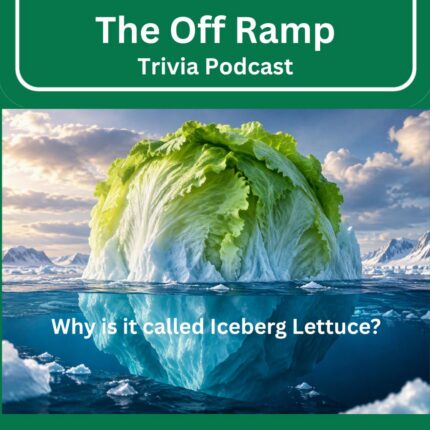
Okay, did you ever wonder why they called it iceberg lettuce?
Marcia Smith 01:18
Well, that’s interesting.
Bob Smith 01:19
Yeah, I was thinking about that one day, and I looked it up, and it is a fascinating story.
Marcia Smith 01:24
I think we’re going to hear it, aren’t we
Bob Smith 01:26
That’s right. Now, iceberg lettuce can be credited to one company, the Burpee Seed Company, the same company that sells seeds to gardeners today. But they were more of a agricultural industry force in those days, not just for gardeners.
Marcia Smith 01:39
Yeah.
Bob Smith 01:39
So when they developed something, it really took hold. Burpee introduced iceberg lettuce in 1894. Now, this is one I never thought about. Lettuce couldn’t be shipped very well before refrigeration. It was almost all lettuce was locally grown.
Marcia Smith 01:53
Yeah, yeah. Oh, so the iceberg ships.
Bob Smith 01:55
No, I’ll explain. Burpee Seed Company wanted a lettuce that stayed crunchy, held a tight head and could survive hot summers better than loose leaf varieties of the day. So they bred this new type of lettuce in Burpee’s test fields in Fort Hook Farm, Pennsylvania. But Burpee didn’t call it iceberg; they called it crisp head cabbage lettuce, which, when you think about it, kind of describes it. It looks like a head of cabbage, right? The name iceberg came from the produce industry because when Western growers began shipping crisp head lettuce cross country, they packed the heads in crushed ice. So by the time the trains rolled into eastern cities, they did look like icebergs. It looked like a big block of ice around all this produce. So customers started calling the lettuce by that name, iceberg.
Marcia Smith 02:41
So customers started, or the receivers.
Bob Smith 02:44
The industry, and the customers.
Marcia Smith 02:45
Oh, very interesting.
Bob Smith 02:46
Not the growers.
Marcia Smith 02:47
Okay.
Bob Smith 02:47
And today, that name would be trademarked by a biogenetics company or something, you know. But that wasn’t possible in 1894. The Supreme Court didn’t let you trademark anything you could grow back then. You can now, and Burpee just wanted to sell seeds, not the lettuce itself, so they did not even apply for a name, so it became a generic term. But iceberg lettuce proved so durable, shippable, and standardized, it became the only lettuce most Americans ever ate until
Marcia Smith 03:13
Until bag lettuce?
Bob Smith 03:14
Until yes, the 1990s. We’ll get into that later.
Marcia Smith 03:18
Okay, lettuce continue.
Marcia Smith 03:20
Letuce go forward. Oh, we are so amusing.
Bob Smith 03:24
Another leaf. Let me show you. Okay.
Marcia Smith 03:27
Okay, Bob. Why were the four presidents on Mount Rushmore selected?
Bob Smith 03:32
Why were they selected?
Marcia Smith 03:33
Okay. First of all, who are they?
Bob Smith 03:35
Okay, they’re George Washington, Thomas Jefferson, Teddy Roosevelt, and Abraham Lincoln.
Marcia Smith 03:39
Correct.
Bob Smith 03:40
And I believe, I think it was just chosen by the sculptor.
Marcia Smith 03:43
Very good.
Bob Smith 03:44
He just said, “This is what I’m going to do.
Marcia Smith 03:46
And did he tell you why? Well, did you read why?
Bob Smith 03:49
Well, I think part of it was they could only put four faces on.
Marcia Smith 03:52
Well, yeah, but there was a reason for each one in his mind. Okay, and I’m going to tell you that. All right. The four prominent U.S. presidents carved into Mount Rushmore were chosen by sculptor Gutzon Borglum to represent major milestones and ideals in American history. George Washington, the first president, was chosen as the symbol of a birth of a nation. Thomas Jefferson represents the expansion of our country through the Louisiana Purchase. Abraham Lincoln was picked for his role in preserving the union, and Theodore Roosevelt symbolizes the nation’s industrial growth. So those are his four. It all made
Bob Smith 03:54
Okay
Marcia Smith 03:54
And I’m going to tell you that.
Marcia Smith 03:56
All right.
Marcia Smith 03:56
The four prominent U.S. presidents carved into Mount Rushmore were chosen by sculptor Gutzon Borglum to represent major milestones and ideals in American history. George Washington, the first president, was chosen as the symbol of a birth of a nation. Thomas Jefferson represents the expansion of our country through the Louisiana Purchase. Abraham Lincoln was picked for his role in preserving the union, and Theodore Roosevelt symbolizes the nation’s industrial growth. So those are his four.
Bob Smith 04:30
It all made sense, didn’t it?
Marcia Smith 04:30
That’s his elevator speech on why he picked those four, and it’s good, right?
Bob Smith 04:34
And they even thought about adding another face, and apparently the granite there won’t support one more face.
Marcia Smith 04:39
Yes, and they’re stellar. They’re they’re the princes of our history.
Bob Smith 04:44
It’s actually a beautiful thing to see in person.
Marcia Smith 04:46
I’ve never seen it. Did you?
Bob Smith 04:47
Oh yeah, I saw it as a kid.
Marcia Smith 04:48
Yeah?
Bob Smith 04:49
Yeah, traveling with my family, and it’s just amazing. And that’s the place that we had a little family incident where we heard somebody say, “Bobby, Susie, Bob, and Nancy, and we thought, “Wow, there’s a family just like.” There, and we moved on, and then later on that vacation, my mom goes, “Where’s my charm bracelet?
Marcia Smith 05:05
Oh, and she had all your names on it.
Bob Smith 05:07
Yes.
Marcia Smith 05:07
And somebody found it and read it out.
Bob Smith 05:09
So we
Marcia Smith 05:10
Isn’t it funny how it doesn’t click?
Bob Smith 05:11
It didn’t click, and we all thought later. Well, why didn’t we get that?
Marcia Smith 05:14
Yeah.
Bob Smith 05:14
But eventually, my mom got the bracelet. My dad and mom called back to the you know the visitor center, and they said we’ve got it, and then they shipped it to us eventually at the end of the vacation. Yeah, okay. Well, you were talking about bagged lettuce.
Marcia Smith 05:28
Yeah.
Bob Smith 05:28
In the late 1980 s, Fresh Express pioneered the first retail bagged salads. Their breakthrough was what they called modified atmosphere packaging. They swapped out most of the oxygen in the bag for nitrogen, which kept the greens fresh long enough to ship nationwide.
Marcia Smith 05:45
Do you remember as a kid seeing any other lettuce in your house? Where were all these lettuces?
Bob Smith 05:50
Well, most
Marcia Smith 05:50
You’d see spinach.
Bob Smith 05:51
Most lettuce was local, unless something could be shipped, and iceberg was the only one shipped.
Marcia Smith 05:56
Oh, really? Yeah.
Bob Smith 05:57
So most Americans only ate iceberg lettuce until the 1990s.
Marcia Smith 06:02
Really?
Bob Smith 06:02
Yeah.
Marcia Smith 06:03
That’s interesting. Okay, so that’s why, because I don’t ever remember seeing anything in the fridge that remotely . . .
Bob Smith 06:09
We grew up – you and I – grew up, went to college, and entered early adulthood with iceberg lettuce being the only lettuce that was around. And it was!
Marcia Smith 06:16
Yeah.
Bob Smith 06:16
And then this is what changed it all: being able to ship things in bagged salads, and the tipping point came in 1994 when shoppers suddenly saw romaine, spring mix, baby spinach, mesclum, and chopped blends next to the iceberg they knew their whole lives. But it wasn’t until the mid 90s.
Marcia Smith 06:34
And this house never sees iceberg. We only eat kale, right, Bob?
Bob Smith 06:38
No.
Marcia Smith 06:39
Tell our children
Bob Smith 06:39
No green leafy and romaine.
Marcia Smith 06:41
You, you love romaine.
Bob Smith 06:42
But restaurants help this too, and Caesar salads made romaine a star.
Marcia Smith 06:46
Yeah.
Bob Smith 06:47
So by the 2000s, salad kits with dressing packets and toppings made lettuce a full meal category.
Marcia Smith 06:52
Yeah.
Bob Smith 06:53
Today, packaged salads are a multi-billion-dollar industry, and they’re the reason most people eat more than one kind of lettuce. Is because of the bagged lettuce industry,
Marcia Smith 07:02
I didn’t know that. Okay, Bob, a particular kind of plastic was invented in 1907 and is still in use today. What is it?
Bob Smith 07:11
Is it a plant-based or is it a petroleum-based?
Marcia Smith 07:13
Oh, is it plant-based?
Bob Smith 07:15
Is it cellophane?
Marcia Smith 07:16
No.
Bob Smith 07:17
Okay.
Marcia Smith 07:17
No, it’s not plant-based. We actually have some of this plastic in our house as a antiquey thing.
Bob Smith 07:23
Oh, really?
Marcia Smith 07:23
And we love it. Actually, we love this plastic. It is Bakelite
Bob Smith 07:27
Oh, Bakelite. Yes, yes.
Marcia Smith 07:29
We have a radio, a tabletop radio, that is beautiful from the – what the 30s?
Bob Smith 07:35
Yes.
Marcia Smith 07:35
And guess who?
Bob Smith 07:37
Mr. Bakelite.
Marcia Smith 07:38
Baeckland.
Bob Smith 07:39
Yeah, there was actually a person with the name or the root name.
Marcia Smith 07:42
Yeah, the root name. The Belgian chemist Leo Baeckland began experimenting with polymers, which are also known as the molecules that make up plastic. He created a new version of plastic called Bakelite in 1907. Historians consider it the first fully synthetic plastic made with virtually no naturally occurring materials.
Bob Smith 08:05
Yes, and you could make it in different colors, so that was a big deal, right?
Marcia Smith 08:08
I just love the way it looks.
Bob Smith 08:09
Oh, me too.
Marcia Smith 08:09
But Bakelite’s popularity skyrocketed, and the heat-resistant plastic was used for everything from irons, kitchen cookware handles, telephones, blah blah blah. You can still
Bob Smith 08:19
And insulators. They used them for insulators for electricity.
Marcia Smith 08:21
That – that’s my finishing line, Bob.
Bob Smith 08:23
I’m so sorry.
Marcia Smith 08:25
You can still find big light used for electrical components today, thanks to its superior insulating properties.
Bob Smith 08:32
And the reason you like it is because of the Art Deco nature of that ring. I like Art Deco. It was great for Art Deco because you could shape it into whatever shape.
Marcia Smith 08:40
Oh yeah,
Marcia Smith 08:41
Geometrics and everything.
Marcia Smith 08:42
It was so cool.
Bob Smith 08:42
It was beautiful looking stuff
Marcia Smith 08:43
back in the day.
Bob Smith 08:44
Yeah. All right, Marcia. What is a light day?
Marcia Smith 08:48
A light is spelled like a light.
Bob Smith 08:49
Well, you know, light years. What is a light day? Talking
Marcia Smith 08:52
Talking about L I G H T?
Bob Smith 08:53
Yes.
Marcia Smith 08:54
A light day. Well, I take it it’s not when there’s no clouds in the sky. I, I don’t know what.
Bob Smith 09:00
It’s the distance light travels in 24 hours.
Marcia Smith 09:04
Oh well,
Bob Smith 09:04
That’s a light day.
Marcia Smith 09:05
Okay,
Bob Smith 09:06
Approximately 16.094 billion miles
Marcia Smith 09:10
In one day.
Bob Smith 09:11
And so far, only one man-made object has ever traveled that far. And what is it? Voyager One. Yeah.
Bob Smith 09:18
A United States satellite launched by NASA in 1977, the first human-made object whose signal takes a full 24 hours to reach Earth, and it finally reached that point in the year 2026.
Marcia Smith 09:30
Yeah,
Bob Smith 09:31
Yeah. It and its sister satellite Voyager 2 sent back the first full-color pictures of Jupiter, Saturn, Uranus, and Neptune years ago, and then just kept going out there, so Voyager One has reached a light day’s distance. That again is 16.094 billion miles, and it’s still communicating with us. And it races along at 37,844 miles per hour. 50 years later, they’re still speeding and. Sending that data back to Earth. They’re not taking pictures. Yeah, their cameras were turned off in the 1990s to conserve power. Their last famous images included a family portrait of the solar system and Carl Sagan’s celebrated pale blue dot image of Earth. So Voyager One is continuing its measuring interstellar space
Marcia Smith 10:18
And send back data. That’s amazing. Well, how long does it take for an actual ray of sun to reach us?
Bob Smith 10:25
I don’t know how long.
Marcia Smith 10:26
How long does it take light to reach Earth from the sun?
Bob Smith 10:30
You’re assuming days. Maybe it’s minutes.
Marcia Smith 10:34
Eight minutes and 20 seconds to travel from the surface of the sun to the Earth.
Bob Smith 10:39
So this thing takes 24 hours to send a signal. The sun is millions of miles away from us. This is billions of miles away from us. It just boggles the mind.
Marcia Smith 10:50
It does. Okay, Bob, you can improve your hand grip strength by 8% by doing what?
Bob Smith 10:58
Exercise. Squeezing your hand, I assume. I don’t know.
Marcia Smith 11:01
Well, you know those hand grips they have.
Bob Smith 11:03
Yes.
Marcia Smith 11:04
You know those aren’t easy, but you can improve your strength with those immediately. Okay. By doing what? Swearing.
Bob Smith 11:12
What?
Marcia Smith 11:12
Yeah.
Bob Smith 11:13
Swearing?
Bob Smith 11:14
Yeah.
Marcia Smith 11:14
Good old Sanford University study in 2024 showed that when participants were asked to repeat a swear word of their choice every three seconds during a Wingate anaerobic power test, their results showed that power increased by 4.5% and their grip strength went up 8% And they tried doing it using neutral words, and nothing happened.
Bob Smith 11:37
So it was swearing that made it.
Marcia Smith 11:38
Yeah, yeah. Scientists can still not explain why, so a timely curse word could very well give you a crucial edge when you need it most, right? That’s amazing. Remember that.
Bob Smith 11:49
All right, Marcia. What country’s incarceration rate is so low they actually rent out their prison cells?
Marcia Smith 11:56
Oh, really? What country? Yes. Oh, some lovely little. I don’t Tahiti.
Bob Smith 12:01
It’s in Europe.
Marcia Smith 12:02
It is Belgium.
Bob Smith 12:04
No, it’s in the Netherlands, so it’s close by.
Marcia Smith 12:07
Okay.
Bob Smith 12:07
Between 2014 and 2024, more than 20 prisons in the Netherlands closed.
Marcia Smith 12:13
Jeez, what a lovely thing!
Bob Smith 12:14
Because of a rapid decline in the prison population.
Marcia Smith 12:17
Do they know why? That’s what I’d
Bob Smith 12:19
love to know, and I did not get that information. But Britannica.com said the country was putting some of the otherwise empty cells to use by leasing them to other countries such as Norway and Belgium to house their incarcerated people.
Marcia Smith 12:32
Wow!
Bob Smith 12:32
But the Netherlands actually had a low incarceration rate, so low they rented out prison cells during a 10-year period. Well,
Marcia Smith 12:40
that’s certainly a good plus in your promotion brochure. I think so.
Bob Smith 12:44
Yeah.
Marcia Smith 12:45
Wow. Okay, Bob, this is of interest to you. What beverage makes humans more attractive to mosquitoes? Oh
Bob Smith 12:52
dear, that must be something I drink. Is it beer by any chance?
Marcia Smith 12:57
It is.
Bob Smith 12:57
Oh dear.
Marcia Smith 12:58
And you hardly drink any. I
Bob Smith 12:59
know. So what’s your excuse? Okay,
Marcia Smith 13:01
yeah, it’s true. According to a 2010 study of mosquito biting preferences, beer makes humans more attractive to these little pests. Researchers found that a mosquito species in the genus responsible for transmitting malaria were more attracted to humans who had consumed just 12 ounces of beer compared to those who consumed only water in a 15-minute period, so just so you know, we
Bob Smith 13:26
just got to know what is the repellent liquid I can. Yeah, there is now. Is it is it root beer? I mean, what would it be?
Marcia Smith 13:32
I don’t know. Well, what did we put out this summer for? That
Bob Smith 13:35
was bees.
Marcia Smith 13:36
Oh, that was bees. Yeah, you put
Bob Smith 13:38
out sweet soda and then put a little bit of detergent in it. A little bit
Marcia Smith 13:41
of dawn.
Bob Smith 13:42
You spoke of Belgium just a moment ago when we were talking about the Netherlands prison cells. You just mentioned was it in Belgium? Here’s a fact about Belgium. Belgium is still dealing with the fallout from World War One.
Marcia Smith 13:54
How so?
Bob Smith 13:55
Each year, Belgium bomb disposal units remove more than 150 metric tons of unexploded ordnance from former World War One battlefields. It’s referred to as the Iron Harvest. It’s a real deadly thing, and sometimes you know people are in farm fields or something, and there’s a mind explodes and maims people or kills animals. It’s really isn’t that where
Marcia Smith 14:16
Princess Di used to go to help raise money? Might be yes. Things I don’t know.
Bob Smith 14:21
All right, I think it’s time for a break.
Speaker 1 14:23
Okay,
Bob Smith 14:24
you’re listening to the Off Ramp with Bob and Marsha Smith. We’ll be back in just a moment. We’re back here on the Off Ramp. We do this each week for the Cedarburg Public Library, Cedarburg, Wisconsin, and then after that, we put it on podcast platforms where it is heard
Marcia Smith 14:38
all over the world.
Bob Smith 14:40
What was it? 21 countries in the last week, or something? Yeah, we’re getting some good reach here.
Marcia Smith 14:45
Can I say something too? That if listeners go to our website, we have more than 320 shows there, and you can just listen to your heart’s content.
Bob Smith 14:54
It’s something you can listen to at all times because they don’t go out of date. All you have to do is go to the off-ramp. Dot show the off-ramp dot show. Better yet, put that into your podcast app on your smartphone.
Marcia Smith 15:06
All right, Bob. Who discovered the Rosetta Stone?
Bob Smith 15:10
The Rosetta Stone was discovered by one of Napoleon’s soldiers. What
Marcia Smith 15:14
are you reading that
Bob Smith 15:15
in the French army?
Marcia Smith 15:16
Did you read my copy?
Bob Smith 15:17
No, no, I knew that. You did? Yeah, this was during Napoleon’s incursions into Egypt and the Middle East.
Marcia Smith 15:23
Yes, you’re absolutely right.
Bob Smith 15:25
I’m so sorry that I know the answer to your question. Me too.
Marcia Smith 15:28
Very good, Bob. The Rosetta Stone is one of the greatest discoveries in the history of archeology, proving crucial to the translation of Egyptian hieroglyphics. Yet it was discovered not by a researcher or scientist or
Bob Smith 15:43
archeologist,
Marcia Smith 15:44
archeologist, but by a soldier in Napoleon’s army, Officer Pierre Francois Xavier Bouchard. In 1799, Napoleon was young general and a rising military star, attempting to conquer Egypt. His troops uncovered the Rosetta Stone while preparing for battle in Alexandria, he recognized it as something unique. He had it transported to Cairo for study, and the Rosetta Stone remained there until 1801, when Napoleon forces in Egypt were defeated by the British, and the artifact was transported to the British Museum,
Bob Smith 16:19
which we saw
Marcia Smith 16:19
in London. We saw, and it remains there to this day. Yes, you’re right. We saw it.
Bob Smith 16:24
And what’s the significance of the Rosetta Stone? Had the same thing written in three different languages. If
Marcia Smith 16:29
they could crack one, then they were able to crack all the languages exactly. And it
Bob Smith 16:33
took a lot of years for that to happen. Yes, a lot of years to do. I believe what
Marcia Smith 16:37
a what a job that would be if you like puzzles.
Bob Smith 16:40
This tells you a little bit about Napoleon’s wars. He always took scientists along too, so they were always sampling things, bringing back plants and bringing back artifacts and identifying things. All right, Marcia, I’ve got another story for you here. Another question: How does a lottery in one country stop tax evasion?
Marcia Smith 16:58
Evasion.
Bob Smith 17:00
Yes, a lottery in one country stops tax evasion.
Marcia Smith 17:05
Because you can, I don’t know. This was
Bob Smith 17:08
a brilliant move. But I’m
Marcia Smith 17:09
trying to think of how it would work. Go ahead, tell me.
Bob Smith 17:11
This isn’t Taiwan. Every shopping receipt in Taiwan is a lottery ticket. Oh
Marcia Smith 17:16
my gosh, how clever! They set
Bob Smith 17:18
up this lottery system in 1951 to combat unrecorded and therefore untaxed transactions. They said, you know, people are doing all kinds of buying and selling, and we’re not getting the tax benefits. We’ll turn every tax receipt into a lottery receipt. Wow! So Taiwanese tax revenue jumped 75 percent the year the lottery started. Brilliant! Why doesn’t everybody do that? I thought it was wonderful. Would
Marcia Smith 17:42
that work for us?
Bob Smith 17:43
I think so, and it’s not a coercive thing. It’s like everybody gets a chance at the fortune. Yeah,
Marcia Smith 17:47
and you don’t have to buy a lottery ticket. Wow, I love that.
Bob Smith 17:51
I thought that was good too.
Marcia Smith 17:53
Okay, Bob, it’s time for Marsha’s Where in the World. Okay, I’ll give you three clues, and you get three guesses. Guesses.
Bob Smith 18:00
Okay.
Marcia Smith 18:01
Okay. Over 50% of this city’s residents were born outside their country. The city has more than 180 languages and dialects that are spoken across the city.
Bob Smith 18:12
Hmm. It’s not New York City, is it?
Marcia Smith 18:14
Clue number two.
Bob Smith 18:15
Okay. It
Marcia Smith 18:16
has an underground pedestrian network spanning more than 17 miles, with over 1,200 shops, restaurants, and services all underground.
Bob Smith 18:25
It’s not Beijing, is it?
Marcia Smith 18:27
Clue number three.
Bob Smith 18:28
All right. It is
Marcia Smith 18:29
often referred to as Hollywood North, and is considered one of North America’s largest film production centers.
Bob Smith 18:37
Really, it’s not San Francisco, is it? Nope. All right, where is it? It
Marcia Smith 18:40
is Toronto.
Bob Smith 18:41
Oh no, kidding!
Marcia Smith 18:42
Yep, Canada. And did you know that Toronto is a Mohawk word that means the place where trees stand in water? No, I didn’t know that. That’s interesting.
Bob Smith 18:52
I love those Native American names. Yeah, the place where trees stand in water. And
Marcia Smith 18:56
Milwaukee, you know what that means?
Bob Smith 18:57
Land between the rivers.
Marcia Smith 18:58
Between the water.
Bob Smith 18:59
So Toronto has this underground maze. Yeah,
Marcia Smith 19:02
I didn’t know about that either. It’s not a maze; it’s a network. 1200 restaurants, shops, and services.
Bob Smith 19:08
But the thing that threw me off was the first part of your question, dealing with the different languages.
Marcia Smith 19:13
Yes, over 50% of the city’s residents were born outside the country. Has more than 180 languages and dialects that are spoken across the city.
Bob Smith 19:24
And you never think of Canada that way. You think of English or French. That’s what you think. Yeah, that’s right. I
Marcia Smith 19:29
had no idea. Have you ever been to Toronto? Oh
Bob Smith 19:31
yes, huh?
Marcia Smith 19:31
I did too when I was a little girl. I remember it being beautiful.
Bob Smith 19:35
I went up to the large tower there. That was the Canadian National Railroad Tower. I went to a ball game there. Saw the Toronto BLJs play.
Marcia Smith 19:43
See, if you live in the Midwest, that’s probably one of the first countries you go to as a little kid because your your family had cars. That’s right. Let’s go to Canada. All
Bob Smith 19:52
right, Marcia. Why does the Starbucks trademark use a two-tailed mermaid?
Marcia Smith 19:58
Well, that’s obvious.
Bob Smith 19:59
Well.
Marcia Smith 20:00
I don’t know
Bob Smith 20:01
why a coffee company uses a mermaid as its logo.
Marcia Smith 20:04
Why?
Bob Smith 20:05
Well, Starbucks was born in Seattle, which was a city based on shipping and fishing in the sea. When the founders of Starbucks went looking for a logo back in 1971, they dug through old nautical books and they found a 16th century wood coat of a twin-tailed siren. Now, in mythology, sirens lured sailors with their irresistible songs. So Starbucks liked the metaphor coffee as an irresistible lure. Wow! So that’s why they developed, you know, the image.
Marcia Smith 20:32
Yeah, it is unusual. That’s
Bob Smith 20:34
why the brand leans heavily into maritime imagery. Coffee was a seafaring commodity shipped across the oceans, but what about the name Starbucks? Where does that come from? I guess you know that one probably comes from literature.
Marcia Smith 20:47
No. The
Bob Smith 20:48
name Starbuck?
Marcia Smith 20:48
No.
Bob Smith 20:49
Oh, the calm, level-headed first mate in Herman Melville’s Moby Dick.
Marcia Smith 20:53
Oh God. He
Bob Smith 20:54
was named Starbuck.
Marcia Smith 20:55
I didn’t know that.
Bob Smith 20:56
Nothing to do with coffee. Did
Marcia Smith 20:57
you ever read Moby Dick?
Bob Smith 20:58
No, nobody does. The founders simply wanted a name that sounded nautical, and they tried Pequod, the name of Ahab’s ship, but they decided it didn’t sound right. Starbuck did, and that’s how the two-tailed mermaid siren and a quiet first mate from Moby Dick ended up on millions of coffee cups around the world.
Marcia Smith 21:16
Okay, Bob. During World War II, what candy was often used as an informal hard currency across war-torn Europe and the Pacific Theater,
Bob Smith 21:25
Tootsie Rolls.
Marcia Smith 21:26
Wrong.
Bob Smith 21:26
Okay.
Marcia Smith 21:27
Hershey bars. Oh, really? Yeah. Okay. In areas where standard cash had little value, the Hershey bar was traded for food services and assistance from local resistance fighters that had the soldiers. I bet your dad this had Hershey bars in his back pocket.
Bob Smith 21:43
Probably did, and the kids were saying chocolate, Joe. Yeah, yeah.
Marcia Smith 21:46
I think you see that in movies. Yes, that’s right. World War Two movies.
Bob Smith 21:50
Okay, I have a question for you.
Marcia Smith 21:51
Yes, sir.
Bob Smith 21:51
Why did the handler kids grow up resenting their names?
Marcia Smith 21:56
Who are the handler kids?
Bob Smith 21:58
Ken and Barbara Handler. Come on, you know this, doesn’t everybody?
Marcia Smith 22:04
Barbie.
Bob Smith 22:04
That’s right, Barbie and Ken. Yeah, their names were Barbie and Ken, and their mother named the dolls after them. The Barbie doll was introduced in 1959, named after Barbara Handler, daughter of Mattel co-founder Ruth Handler, and Barbara herself said she hated being known as the real Barbie. She said people would come up to her asking for her autograph, and you can imagine she was 18 when the doll was introduced. Probably hated this.
Marcia Smith 22:28
Oh yeah, teenagers would hate it.
Bob Smith 22:29
Her brother Kenneth Handler was the inspiration for the Ken doll in 1961. He’d told the Los Angeles Times the Ken doll was a perfect beach blonde surfer. He was very different from that. In his words, I was a piano playing, foreign film watching nerd. Oh,
Marcia Smith 22:43
that’s funny.
Bob Smith 22:44
And he said, even though Barbie made him a millionaire several times over because he inherited all this stuff, he said he would have bought his daughter’s Barbie dolls if they’d asked for them, but they wanted stuffed animals instead. And he’s going on to the great beyond. He’s already he retired and then he passed away, but
Marcia Smith 23:01
great beyond. Well, he’s up
Bob Smith 23:03
in Mattel land somewhere there, apparently.
Marcia Smith 23:05
Okay.
Bob Smith 23:07
Anyway, both of them were a little annoyed by the whole thing, so it turns out being immortalized in plastic isn’t always a glamorous thing. But if
Marcia Smith 23:14
it makes you rich, it can be endured. Yes,
Bob Smith 23:17
you can endure that. I could endure Bob Smith dolls. Yeah, they never had those though.
Marcia Smith 23:22
Martian Bob dolls coming to Target near you. Okay, we we Bob, we didn’t have drones during World War II, but the United States developed an experimental weapon called Project X-ray, and they used a live animal to deliver
Bob Smith 23:37
it. Oh dear!
Marcia Smith 23:38
What was the animal used in Project X-ray,
Bob Smith 23:41
Project X-ray, and it was actually using some kind of
Marcia Smith 23:44
a an animal.
Bob Smith 23:45
Wow! I don’t know. I never heard of this story. Me
Marcia Smith 23:48
either. It was live bats.
Bob Smith 23:50
Oh, no kidding. The
Marcia Smith 23:51
bats didn’t drop the bombs themselves. The bats were the delivery system. FDR approved the concept developed by dentist Dr. Lyle Adams, which involved the bats being fitted with a small, tiny napalm or kerosene incendiary device, the plan was to drop 1000 chilled hibernating bats from an airplane at dawn, and in midair the bats would wake up and scatter to hide in dark eaves and attics on nearby buildings before their timed charges ignited,
Bob Smith 24:22
where was that going to be? In the Japanese islands or something? It
Marcia Smith 24:25
didn’t say. It just said during World War II. But what could possibly go wrong? Oh yeah. Well, during testing at Carlsbad Army Airfield in New Mexico, 1943, armed bats accidentally escaped and roosted under a test hangar and the general’s car burning down big parts of the military base and blowing up his car. Anyway, the project was canceled in 1944.
Bob Smith 24:50
Well, see, you know, you’re using animals. What could possibly go wrong? Well, a lot of things could go wrong. They’re not trained to do what you want them to do.
Marcia Smith 24:56
Yeah, I can’t believe that they’d be fitted with. Napalm and kerosene.
Bob Smith 25:01
Well, here’s a question for you, similar one. In what war were night vision scopes first used?
Marcia Smith 25:07
Well, I would say World War II, but that would be the obvious answer. So I’ll. Why would that be
Bob Smith 25:14
the obvious answer? I would think it would be the Gulf War. Gulf War, yeah. Yeah, that’s where I remember them coming and. Okay, it
Marcia Smith 25:20
seems to me I’ve seen movies with it on, but okay, I’d say a World War II. And you’re
Bob Smith 25:25
absolutely right. Of
Marcia Smith 25:26
course I am.
Bob Smith 25:26
World War II. In fact, night vision scopes were credited with helping turn the tide in the Pacific Battle on Okinawa. Japanese armed forces strategically used darkness to launch surprises at night. Well, starting in late 1943, researchers at the National Defense Research Committee and RCA, the Radio Corporation of America, developed the M1 and M3 Sniper Scope and handheld Snooper scope devices. These were night vision, and they functioned like invisible flashlights. They would reflect invisible infrared light off of people or vehicles, and this was all kept secret even after the war. Nobody knew how we did so well at Okinawa, and it was because of these night vision. They were not built for soldiers on the run. Oh, two and three man teams had to place these heavy battery packs beside these things in foxholes, and they just kept sweeping the beams across the battlefield like searchlights at night, but the enemy didn’t know that. And only 200 units reached Okinawa. But post-war evaluations say that those weapons, equipped with the night vision, accounted for 30 percent of Japanese casualties on Okinawa. So it was a top-secret invention in World War II and into the early Cold War.
Marcia Smith 26:39
Interesting. I’m ready for my quotes. Is there anything else you want to say? Nope,
Bob Smith 26:42
that’s it.
Marcia Smith 26:43
Any other questions? Nope, that’s it. All right, Bob. Unhappiness, Buddha. Learn to let go. That is the key to happiness.
Bob Smith 26:50
As long as you’re letting go of unhappiness. Abe Lincoln. I mean, really, come on.
Marcia Smith 26:55
Abe Lincoln, who had a fair share of unhappiness. We are as happy as we make up our minds to be
Bob Smith 27:01
well. I think that’s true.
Marcia Smith 27:03
I think that’s it’s all
Bob Smith 27:04
that whole thing about life is not about your actions so much as your reactions.
Marcia Smith 27:09
Yeah,
Bob Smith 27:09
how you react to everything that comes in your life.
Marcia Smith 27:12
And Nora Ephron says, if you have teenagers and seek happiness, get a dog. Quote so someone is happy to see
Bob Smith 27:19
you. Oh, that’s true. All right. Well, we hope you were happy to hear us, and we hope you come back again next time when we return with more fascinating facts and tantalizing trivia. I’m Bob Smith.
Marcia Smith 27:30
I’m Marcia Smith.
Bob Smith 27:31
Join us again next time when we return with more great trivia here on the Off Ramp. The Off Ramp is produced in association with the Cedarburg Public Library, Cedarburg, Wisconsin. Visit us on the web at theofframp show.
Transcribed by https://otter.ai